| 1. Overview |
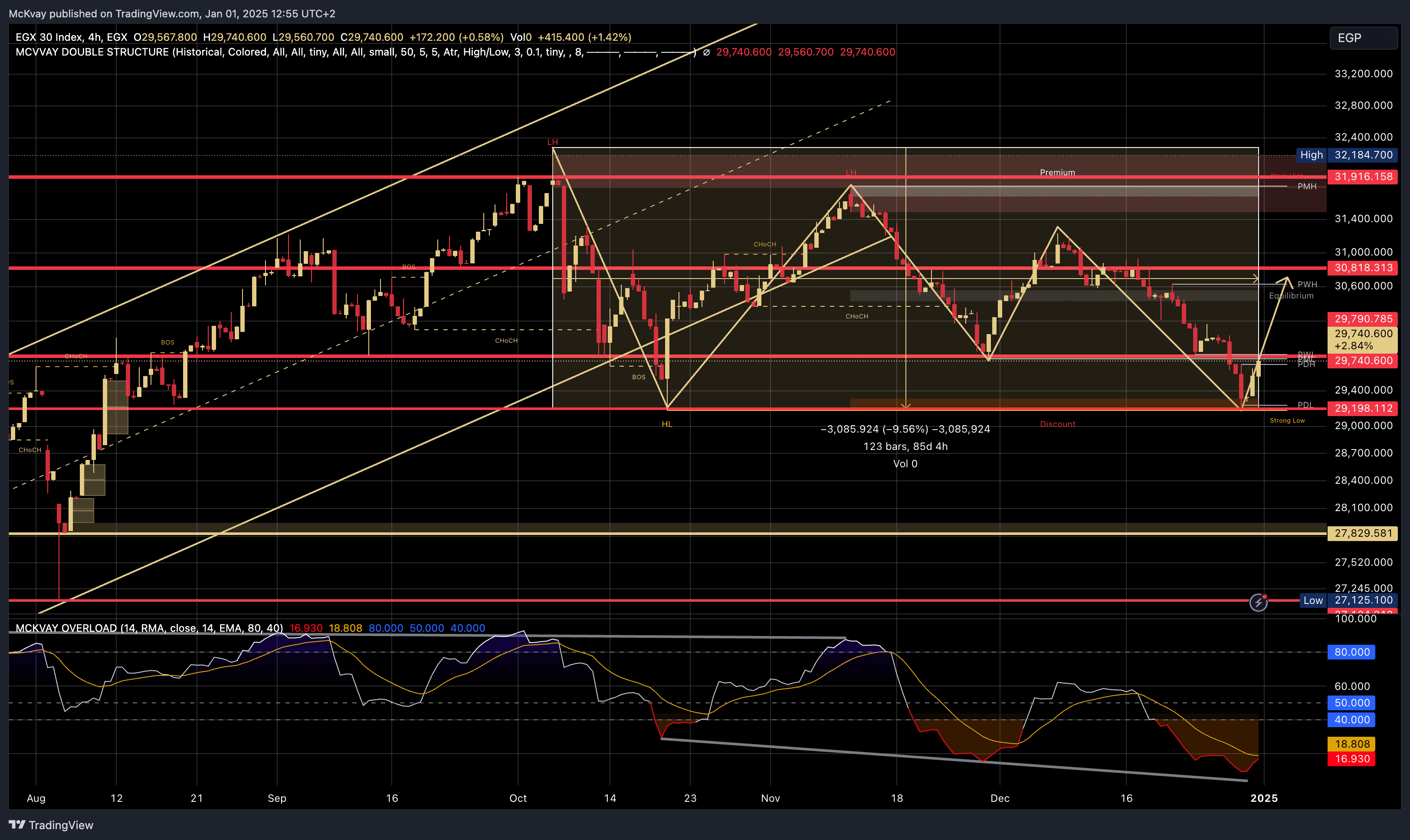
- This analysis focuses on the EGX30 Index on a 4-hour timeframe, emphasizing critical market dynamics, including price trends, key levels, and momentum shifts.
- This analysis combines previous observations with additional details, highlighting the importance of 30,818 as a key resistance, 29,198 as strong support, and the broader implications of market phases and volume trends.
|
| 2. Trend Analysis |
- Primary Uptrend: The price initially followed a strong upward channel, evident from higher highs (HH) and higher lows (HL), reflecting bullish control.
- Temporary Downtrend: A corrective phase with lower highs (LH) and lower lows (LL), indicating a short-term bearish trend while respecting broader bullish boundaries.
- Recent Reversal Signs:
- The price has bounced from the strong low at 29,198.
- Movement toward the equilibrium level (~30,139) signals potential stabilization or an attempt to resume upward momentum.
|
| 3. Key Price Zones |
- 30,818 Resistance Zone:
- The level 30,818 is significant because:
- It lies near the equilibrium level (~30,139) and represents a potential pivot point.
- This area has acted as a short-term resistance where sellers regained control during previous price attempts to recover.
- Reclaiming and sustaining movement above 30,818 would indicate that the market is regaining bullish momentum and challenging the corrective phase.
- Premium Zone (31,800–32,200): Represents potential selling interest, marking a critical resistance level in case the price successfully clears 30,818.
- Discount Zone (29,400–29,198): Reflects strong demand, evidenced by price reactions and rebounds from this support. The 29,198 level acts as a significant floor, with its defense critical for maintaining the broader bullish structure.
- Equilibrium Level (~30,139): Positioned just below 30,818, this level is a balance point for the current range and provides a key test of whether the price will push higher or reverse lower.
|
| 4. Market Structure and Patterns |
- CHoCH (Change of Character): Highlighted points mark transitions in market phases, such as the break from bullish momentum to corrective movements.
- BOS (Break of Structure): Confirmations of bearish moves are visible; however, these do not invalidate the broader uptrend since the price remains above major supports.
- Double Structure Zone: Consolidation areas show overlapping regions of supply and demand, with notable reactions shaping the market’s movement.
|
| 5. Fibonacci and Discount Zones |
- Discount Zone: The 29,198 level, along with the broader discount zone, indicates potential accumulation. Historically, these areas have been of high interest to market participants.
- Premium Zone: The area near 30,818 acts as a critical intermediary resistance within the premium zone. Behavior around this level could signal whether the market will test higher resistance levels near 31,800.
|
| 6. Indicators |
- Oscillator readings suggest the market is recovering from oversold conditions (~18.8), signaling a potential shift toward equilibrium.
- Momentum appears to be stabilizing, though the broader trend will depend on price movements relative to key levels.
|
| 7. Volume and Time Analysis |
- Declining Volume: The reduction in volume during this corrective phase is a positive sign for the market. It suggests that the selling pressure is decreasing, which often aligns with the end of a temporary downtrend.
- Time Analysis: The temporary downtrend (-9.56%) developed over 123 bars (85 days), indicating a medium-term pullback within the broader trend.
|
| 8. New Observations |
- 30,818 Resistance Importance: This level acts as a key intermediary resistance and an inflection point for market recovery. Sustained movement above 30,818 could signify the end of the temporary downtrend and the resumption of bullish momentum.
- 29,198 Strong Support: The lower boundary of the discount zone remains critical for maintaining the market’s broader bullish structure.
|
| 9. Conclusion |
| This analysis emphasizes the 30,818 level as a critical intermediary resistance. It serves as a key checkpoint for the market’s potential recovery, bridging the gap between the equilibrium (~30,139) and higher resistance zones (31,800–32,200). Combined with declining volume and stabilizing momentum, this level is pivotal in assessing the market’s next move. |